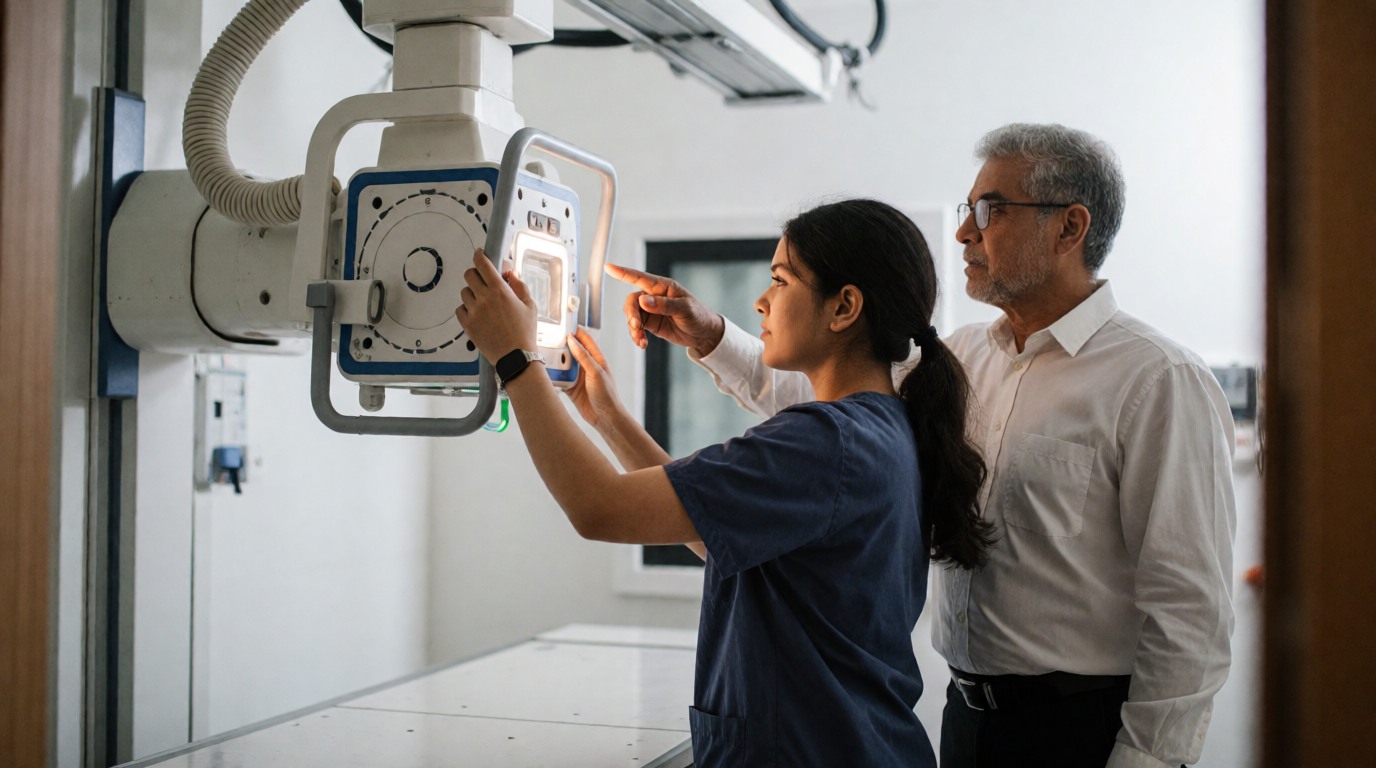

The physician assistant course is a four-year degree you join after Class 12 with Physics, Chemistry and Biology. The national health regulator now calls the profession Physician Associate and the degree B.PA, and its curriculum asks for a 12-month internship and a licensing exit exam before you can practise. Colleges may still advertise the older name.
If you are comparing colleges and fees, start with our BSc Physician Assistant course page. This guide explains what changed in 2026 and what the official documents say you should expect.
Physician assistant course at a glance
| Point | Detail |
|---|---|
| Degree name | Bachelor of Physician Associates (B.PA); many colleges still say BSc Physician Assistant |
| Duration | 4 years: 3 years of classroom and clinical study plus a 12-month internship |
| Eligibility | 10+2 with at least 50% marks in each of Physics, Chemistry and Biology |
| Age | 17 years or more; maximum 40 years in the curriculum |
| Selection | Common entrance test on Physics, Chemistry, Biology and English; cut-off based |
| Mode | On-campus, full time, semester pattern |
| After the degree | M.PA (2 years), then PhD |
| Licence to practise | Degree plus a third-party exit exam |
What changed for the physician assistant course in 2026
The University Grants Commission wrote to universities on 16 September 2026 that a Gazette notification dated 27 August 2026 lists the degrees under the National Commission for Allied and Healthcare Professions (NCAHP). Two entries matter here. B.PA, Bachelor of Physician Associates, is a four-year bachelor's degree open after 10+2. M.PA, Master of Physician Associates, is a two-year degree after a bachelor's. You can read the list in the UGC letter and Gazette notification.
The NCAHP curriculum for the profession explains the name. It recommends the title Physician Associate to separate the Indian profession from the older designation Physician Assistant, and to match international usage. In practice, expect both names on college websites for a while. Before you pay an application fee, ask the college which exact degree it awards.
Physician assistant course eligibility and admission
The NCAHP curriculum handbook for Physician Associates recommends these entry rules:
Pass in 10+2 from a recognised board with at least 50% marks in each of Physics, Chemistry and Biology.
NIOS candidates need a minimum of five subjects including English, Physics, Chemistry and Biology (or Botany and Zoology).
Age of at least 17 years, with a maximum of 40 years.
A physical fitness certificate from a registered medical practitioner and a conduct certificate from the institution last attended.
No lateral entry for now. The curriculum says bridge routes for nurses and other health professionals may be considered later.
Eligibility on paper is not the whole story. The curriculum says only candidates who meet the criteria can sit a common entrance test, preferably at national level, testing Physics, Chemistry, Biology and English, with admission by cut-off marks. These are recommendations, so the university you apply to sets the final rules and the test it accepts. Read its current prospectus before you plan around any one exam. Use our marks percentage calculator to check your PCB marks against the 50% line.
Physician assistant course duration and syllabus
The curriculum describes a 4-year programme: three years of study followed by one year of internship, in eight semesters. Each of the first six semesters carries 28 credits, counted as one credit for every 15 hours of theory and one for every 30 hours of practical work.
| Stage | Subjects |
|---|---|
| Semester 1 | Professionalism, Anatomy I, Physiology I, Biochemistry and Molecular Biology I, Introduction to Microbiology, Introduction to the Healthcare Delivery System in India, Functional English and soft skills, Community Orientation I |
| Semester 2 | Anatomy II, Physiology II, Biochemistry II, Medical Microbiology, Introduction to Computers, Community Orientation II and clinical skills |
| Later semesters | Pathology, Pharmacology and Toxicology, General Medicine, Basics of Surgery and Advanced Surgery, Emergency Medicine, Paediatrics, Obstetrics and Gynaecology, Critical Care, Geriatrics, Non-Communicable Diseases, Medical Ethics and Law |
| Semesters 7 and 8 | Clinical internship: six months in general medicine with a primary care focus, six months in surgery (three months general surgery, three months in a medical or surgical specialty of your choice) |
Hospital time is not an extra. The curriculum builds community engagement into year one and asks for a thesis, completed by the end of semester 6. It also says interns should receive a stipend, and that the teaching institute must arrange an external internship site if its own hospital falls short. Ask every college where its interns are posted and who pays the stipend.
Exit exam and licence to practise
This is the part that differs most from many other science degrees. The curriculum provides for a third-party exit or licensure exam at the end of the third year. It says completing the degree and clearing that exam are both required to begin clinical practice, and that the university issues the degree only after all four years, internship included. The detailed exam rules will follow NCAHP guidelines, so watch the NCAHP and your university for notices.
Can you study the physician assistant course online?
Not in the format the curriculum describes. It specifies on-campus, full-time study in semesters, with supervised clinical postings throughout. A programme that promises the degree entirely online does not match it, so ask for the approval in writing. To confirm that a university is recognised, use our UGC recognised universities list.
Where the physician assistant course leads
The curriculum says the profession began in India in 1992, when physician assistants were trained through a two-year postgraduate diploma in private tertiary hospitals, mainly for cardiology and cardiothoracic surgery. It reports more than 130 institutions offering such programmes and an estimated 10,000 practising physician assistants, mostly in private hospitals, across specialties such as cardiology, nephrology, oncology, neurosurgery and obstetrics.
The profession works under the supervision of a physician. It is not a route to practising independently, and the degree is not an MBBS. For higher study, the curriculum lays out M.PA and then PhD. No official national salary figure exists for the role, so ask each employer for the pay band in writing and use our in-hand salary calculator to turn a CTC into monthly take-home.
Physician assistant course fees and loans
Fees depend on the college, and government seats cost far less than private ones. Ask for the total for all four years, including the internship year, in writing. If you plan to borrow, run that total through the education loan EMI calculator before you confirm a seat.
Physician assistant, nursing or MLT: which suits you
Choose B.PA if you want to work beside doctors on history-taking, examination support and clinical documentation, and you are happy with long hospital postings.
Look at nursing if you want direct, continuous patient care. Our BSc nursing course page covers that route.
Look at medical laboratory science if you prefer the diagnostic laboratory to the ward. Our BSc MLT guide explains it.
Frequently asked questions
What is the physician assistant course?
It is a four-year undergraduate degree after Class 12 science that trains you to support physicians in clinical care. Under the NCAHP the degree is called B.PA, Bachelor of Physician Associates, and the profession is called Physician Associate.
What is the eligibility for the physician assistant course?
The NCAHP curriculum recommends 10+2 with at least 50% marks in each of Physics, Chemistry and Biology, a minimum age of 17 and a maximum of 40, plus a fitness and a conduct certificate. Your university sets the final rules.
How many years is the physician assistant course?
Four years in the curriculum: three years of study and a 12-month internship, spread over eight semesters.
Is there an entrance exam for the physician assistant course?
The curriculum describes a common entrance test, preferably national, on Physics, Chemistry, Biology and English, with admission on cut-off marks. Check which test your target university accepts.
Is an exit exam compulsory for physician assistants?
Yes, according to the curriculum. It provides a third-party exit or licensure exam at the end of the third year, and both the degree and the exam are needed to begin clinical practice.
Can I do the physician assistant course online or after a diploma?
The curriculum describes on-campus full-time study and says no lateral entry is allowed for now. A fully online route does not fit that description.
Get personalised college recommendations based on your profile.
Compare placements, cut-offs, and fees across 400+ colleges, for free.
Explore Colleges →