B.Sc radiology and imaging technology, often shortened to BMRIT or B.Sc MRIT, is a four-year allied health degree: three years of classroom and clinical study followed by a one-year hospital internship. You join after Class 12 with Physics, Chemistry and Biology, and you train to run X-ray, CT, MRI and ultrasound equipment. Our B.Sc Radiology course page covers the programme overview; this guide explains the structure, entry rules and semester subjects.
What B.Sc radiology and imaging technology is
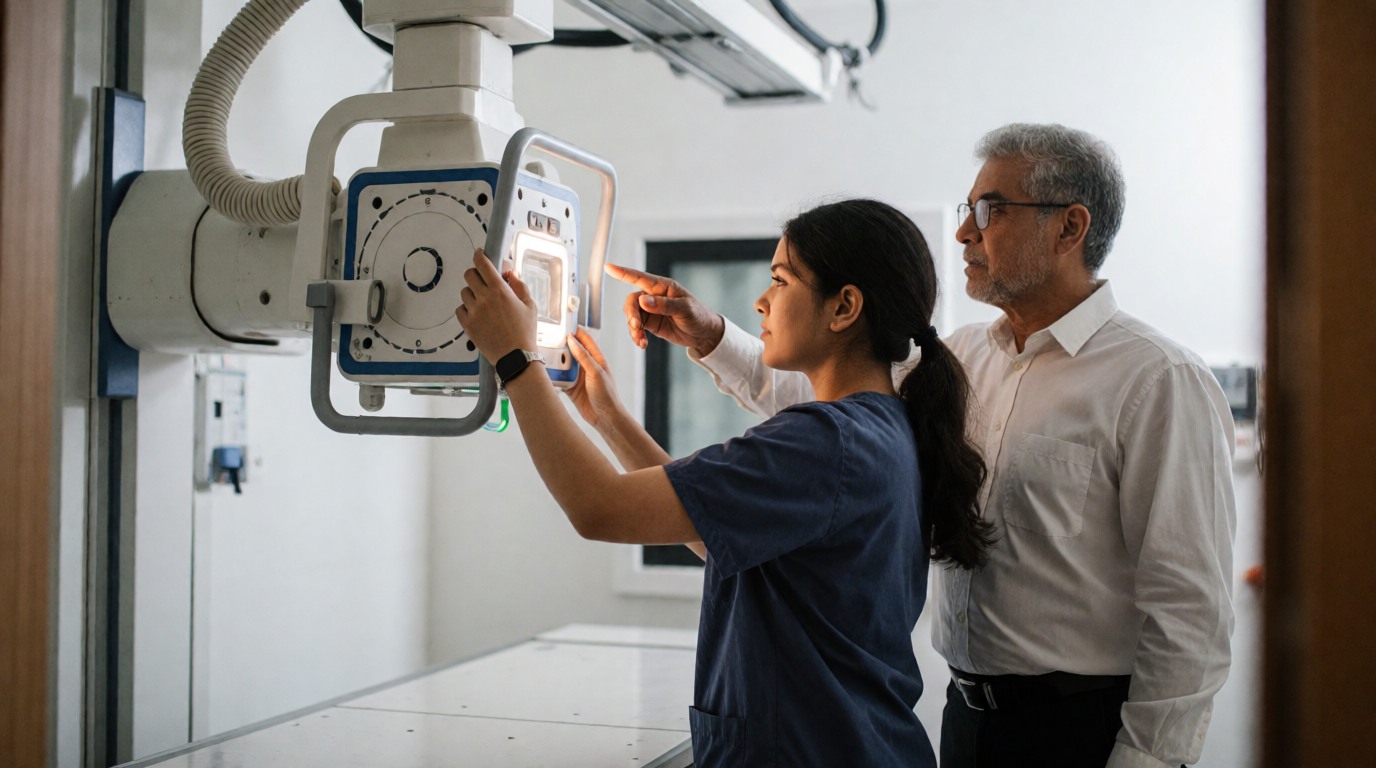
The programme trains radiographers and imaging technologists: the people who position the patient, operate the machine and produce the scan that a radiologist reads. It is not a medical degree, and a graduate does not diagnose. The Ministry of Health and Family Welfare's model curriculum handbook for medical radiology and imaging technology (2015-16) recommends the title Medical Radiology and Imaging Technologist and places a B.Sc holder at entry level 5 of the career ladder, one step above a diploma holder.
Colleges use several names for the same course: B.Sc Radiology, B.Sc Medical Radiology and Imaging Technology, Bachelor of Medical Radiology and Imaging Technology (BMRIT) and B.Sc Radiography. Check the syllabus, not just the title, when you compare offers.
Duration and structure
| Item | Detail |
|---|---|
| Total duration | 4 years, 8 semesters, full-time |
| Study phase | 3 years, semesters 1 to 6 |
| Internship | 1 year, semesters 7 and 8; 2,400 internship hours |
| Total credits | 170 |
| Attendance needed | 75% in theory and 75% in practicals, counted separately |
| Pass mark | 50% in theory and 50% in practicals, counted separately |
| Internship stipend | Minimum Rs 7,000 a month, or as per NCAHP norms |
Because of the 2,400 internship hours and the practical training in every semester, this is a campus and hospital programme. We do not list an online or distance route for it.
B.Sc radiology and imaging technology eligibility
Qualification: Class 12 or equivalent from a recognised board with Physics, Chemistry and Biology.
Age: at least 17 years on or before 31 December of the admission year. The curriculum document also sets a maximum age of 30.
Documents: a physical fitness certificate from a registered medical practitioner and two character references from non-relatives.
Marks: the curriculum text names no minimum percentage, but individual colleges set their own. Manipal, for example, asks for 50% aggregate in Physics, Chemistry and Biology on its B.MRIT page.
How selection works
The curriculum document lists merit in NEET as the selection route. In practice universities decide this themselves: Manipal admits through its own Manipal Entrance Test, weighting the test score and Class 12 marks 50% each, and not through NEET. Ask each college which test it accepts and which year's rule applies to you. Our BSc courses list shows how this course sits among the other science degrees you can take after Class 12.
Semester-wise subjects
| Semester | Main subjects |
|---|---|
| 1 | Human Anatomy, Physiology, Basics of Radiation Physics, Medical Terminology, Medical Law and Ethics, English and Communication Skills |
| 2 | Basics of Microbiology, Basics of Biochemistry, Conventional Radiography and Equipment, Clinical Radiography Positioning Part I |
| 3 | Pathology, Clinical Radiography Positioning Part II, Radiography and Image Processing Techniques, Contrast Media and Special Radiological Procedures |
| 4 | Cross-Sectional Anatomy, Modern Radiological Imaging Equipment and Physics, Interventional Radiology Techniques, Patient Care in Radiology |
| 5 | Basic Techniques in CT Technology, Radiation Safety in Diagnostic Radiology, Quality Assurance and Regulatory Requirements |
| 6 | Basic Techniques in MRI Technology, Introduction to Nuclear Medicine Techniques, Ultrasound Techniques, Biostatistics and Research Methodology |
Every semester also carries a Radiology Clinical Education part, which is supervised time in the hospital department. Radiation safety gets its own paper in semester 5, so expect to be examined on it before you reach the internship.
What the internship covers
The final year is a rotation through the imaging department. The curriculum fixes the split across 12 months, so you see every modality before you choose where to work.
| Posting | Months |
|---|---|
| Conventional radiography, mammography, CR, DR and PACS | 4 |
| Computed tomography (CT) | 2 |
| Magnetic resonance imaging (MRI) | 2 |
| Radiological imaging, special procedures and advanced equipment | 2 |
| Ultrasonography and Doppler imaging | 1 |
| Interventional radiology | 1 |
The document says the internship must be completed within 18 months of passing the final examination, so plan it straight after the sixth semester.
Diploma to B.Sc: lateral entry
If you already hold a diploma in medical imaging technology or radiography, the curriculum allows lateral entry into semester 3. You need Physics, Chemistry and Biology at Class 12 (or studied during the diploma if your Class 12 was Arts or Commerce) and at least one year of radiology work experience. Lateral entry seats are capped at 10% of the annual intake. The document also records a task-force recommendation to NCAHP to phase out the diploma course within five years, which makes the degree the safer long-term route.
Jobs and further study
The curriculum lists these routes after the degree:
Hospital roles: radiographer, X-ray, CT, MRI and mammography technologist, cath lab and interventional technologist.
Technical and quality roles: applications specialist, radiological safety officer, quality control technologist, PACS manager.
Management and industry: diagnostic manager, imaging department administration, sales and applications work with equipment companies.
Teaching and research: faculty and research posts in medical colleges.
Further study: a two-year M.Sc in the same field, then PhD.
We have not quoted a salary here, because no official source publishes pay for this job title. Ask the college for its placement report and read it against the in-hand figure, not the package.
Fees and how to compare colleges
Fees vary widely between a government college and a private university. As an example, Manipal lists Rs 7,21,000 for general-category 2026 admissions on its page, which covers the full programme and is not typical of every college. If you plan to borrow, use the education loan EMI calculator before you commit. Check that the university is on the UGC recognised universities list, and look at the NIRF medical ranking for institutions that are ranked.
Related courses to compare
If the lab and patient side appeals more than imaging, compare it with B.Sc MLT or the physician assistant course. For work inside the operating theatre, see the B.Sc operation theatre technology course. Students leaning towards direct patient care can read our BSc nursing guide.
Frequently asked questions
What is B.Sc radiology and imaging technology?
It is a four-year allied health degree that trains you to operate X-ray, CT, MRI and ultrasound equipment. Three years are study and one year is a hospital internship, according to the 2026-27 NCAHP-based curriculum we read in November 2026.
What is the eligibility for BMRIT?
Class 12 with Physics, Chemistry and Biology, an age of at least 17 on 31 December of the admission year, and a medical fitness certificate. Individual colleges add their own minimum marks.
Is NEET compulsory for B.Sc radiology?
The curriculum document lists NEET merit, but universities choose their own route. Manipal, for instance, admits through its own entrance test, so check each college.
Can I do B.Sc radiology online?
No. The course needs 2,400 hours of hospital internship plus clinical education in every semester, so it is taught on campus and in hospitals.
Can a diploma holder join the B.Sc directly in the second year?
A diploma holder with Physics, Chemistry and Biology and one year of radiology experience can enter semester 3 under lateral entry, which is capped at 10% of seats.
What can I study after B.Sc radiology?
The curriculum points to a two-year M.Sc in medical radiology and imaging technology, and then a PhD.
Get personalised college recommendations based on your profile.
Compare placements, cut-offs, and fees across 400+ colleges, for free.
Explore Colleges →