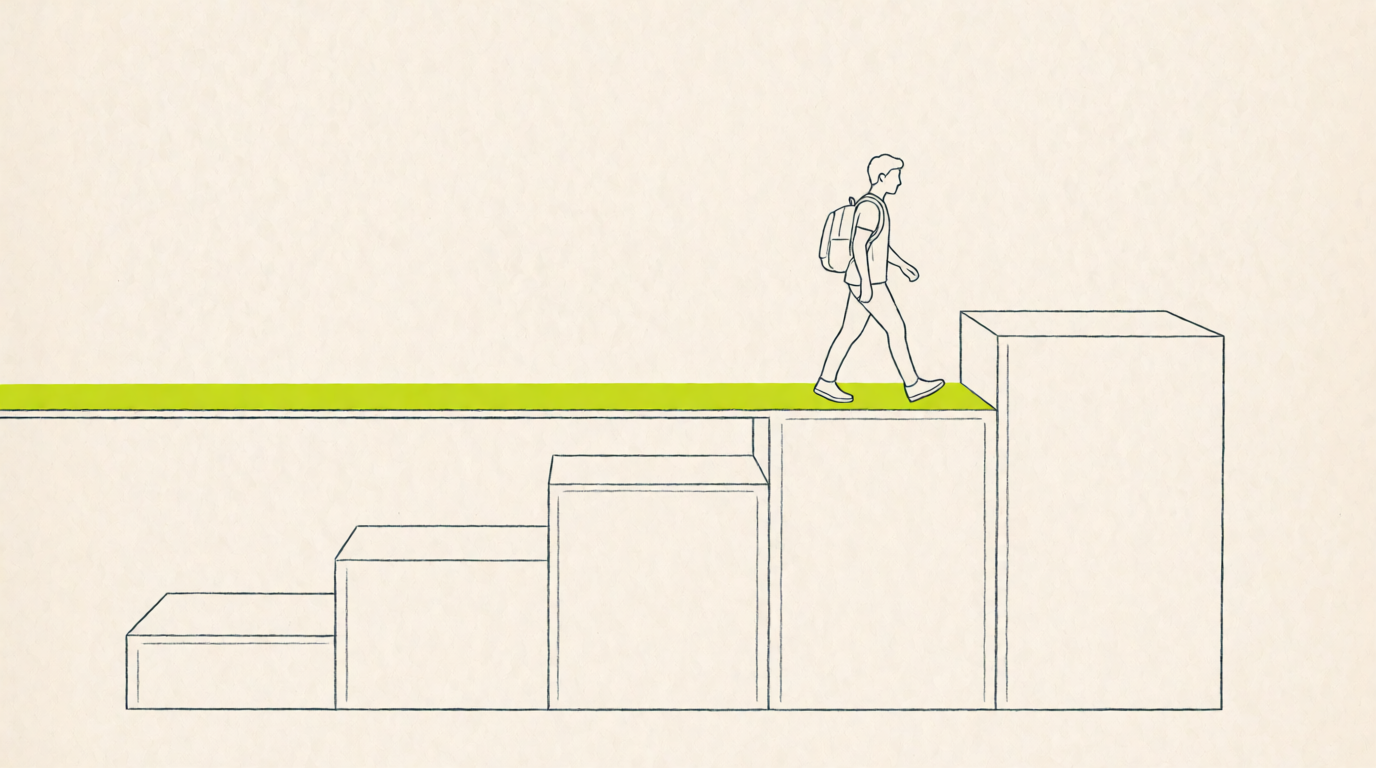
B Tech lateral entry lets you join the second year of a regular B.Tech after a diploma in engineering, so you finish the degree in three years instead of four. Under AICTE rules you need at least 45% in the diploma (40% for reserved categories). A B.Sc. with Mathematics in Class 12 also qualifies. Admission runs through state tests such as AP ECET and Karnataka's DCET.
This post covers the rules, the seats and the state exams behind lateral entry. For colleges, fees and a quick comparison of options, see our B.Tech after diploma course page. Every rule below comes from the AICTE Approval Process Handbook 2024-2027 or an official 2026 state admission document.
B Tech lateral entry eligibility under AICTE rules
| Your qualification | Minimum marks | Condition |
|---|---|---|
| Three-year diploma, or two-year lateral entry diploma, in any branch of engineering and technology | 45% (40% for reserved categories) | Joins the second year of the B.E./B.Tech |
| B.Sc. degree from a UGC-recognised university | 45% (40% for reserved categories) | Must have passed Class 12 with Mathematics |
| B.Voc. or three-year D.Voc. | No separate minimum stated | Must be in the same or an allied sector |
The AICTE Approval Process Handbook also says universities will offer bridge courses such as Mathematics, Physics and Engineering Drawing for students who come from different backgrounds. If you are joining from a B.Sc. or a vocational route, ask the college what bridge courses it runs and when, because they add to your second-year load.
Notice that the AICTE rule says a diploma in any branch of engineering and technology. States can still set an order of preference by branch, as Andhra Pradesh does below, so the branch you can get depends on your state's rules as well as your rank.
How many lateral entry seats are there?
Lateral entry seats are added on top of a college's approved intake. The AICTE handbook allows up to 10% of the approved intake as supernumerary seats, plus any first-year seats that stayed vacant, including seats left empty when first-year students withdrew. So a branch with 60 approved seats can take up to 6 lateral entry students, and more if first-year seats went unfilled.
Colleges do not all use this route equally. In the data they reported to NIRF in 2025, Jadavpur University admitted 121 students to its four-year undergraduate engineering programmes through lateral entry in 2021-22, while NIT Tiruchirappalli reported none for the same year. Before you build a list, check that the colleges you like actually admit lateral entry students in your branch.
Tuition Fee Waiver seats also cover lateral entry
The AICTE Tuition Fee Waiver scheme applies to lateral entry admissions too. If your parents' annual income from all sources is ₹8 lakh or less, you can be considered for a waiver of tuition fee. Up to 5% of a course's approved intake is set aside for this, and the state admission authority runs a separate merit list. Other fees still apply. For what tuition itself costs at different colleges, see our guide to B.Tech fees in India.
Lateral entry entrance exams and counselling by state
There is no single national lateral entry exam. Each state runs its own test or merit process and counselling, often with domicile rules; AP ECET, for example, requires candidates to belong to Andhra Pradesh. Here are two official examples for 2026.
| State and exam | Who runs it | Key rules for 2026-27 |
|---|---|---|
| Andhra Pradesh: AP ECET 2026 | JNTU Anantapur, on behalf of APSCHE | Exam held on 23 April 2026, results on 7 May 2026. 200 objective questions: Mathematics 50, Physics 25, Chemistry 25 and the remaining 100 based on diploma branch subjects. Candidates must belong to Andhra Pradesh. |
| Karnataka: DCET 2026 | Karnataka Examinations Authority (KEA) | Separate online applications for regular diploma candidates and for diploma-holding working professionals, with online option entry for both. |
The AP ECET 2026 instruction booklet adds three rules worth knowing. Lateral entry seats are 10% over and above the sanctioned intake. B.Sc. candidates are considered only after all qualified diploma holders have been admitted. And for Computer Science and IT, diploma holders from those branches get first preference, with remaining seats going to diploma holders from any branch on merit. Karnataka's process, including the working professionals track, is on the KEA DCET 2026 page.
Other states run their own tests and counselling, so look up your state's technical education directorate or admission authority well before your final diploma exams. AP ECET 2026, for example, was notified on 4 February 2026, and missing the form usually means waiting a full year.
Is B.Tech lateral entry worth it?
For most diploma holders who want an engineering degree, yes. You save a year of fees and time, and your diploma has already covered much of the practical groundwork. The AP ECET booklet describes these seats as admission into the second year of the regular B.E. and B.Tech, so you join the same programme as everyone else in your batch.
The trade-offs are real, though. Second-year subjects assume the first-year maths and science you skipped, which is why AICTE asks universities to run bridge courses, so plan to put extra time into Mathematics in your first semester. Your branch choice can be narrower than for first-year students, and the best colleges in your state may have only a few lateral seats per branch.
A degree also opens jobs a diploma does not. PSU trainee posts recruited through GATE, such as NTPC's Engineering Executive Trainee, ask for a full-time B.E./B.Tech, as our guide to mechanical engineer salary in India explains, while a diploma alone already qualifies you for many SSC Junior Engineer posts.
Already working? Look at the working professionals route
If you have a diploma and a job, a regular lateral entry seat means leaving work for three years. Some states, Karnataka among them, run a separate lateral entry track for diploma-holding working professionals. Read our page on B.Tech for working professionals before you choose, and confirm that the programme you join is approved by AICTE for that mode. To compare lateral entry colleges and seats in your state, go back to the B.Tech after diploma page.
Frequently asked questions
What is the eligibility for B.Tech lateral entry?
Under the AICTE Approval Process Handbook 2024-2027, you need a three-year diploma (or two-year lateral entry diploma) in any branch of engineering and technology with at least 45% marks, or 40% for reserved categories. A B.Sc. with 45% (40% reserved) and Mathematics in Class 12, or a B.Voc./three-year D.Voc. in the same or an allied sector, also qualifies.
Can a B.Sc. student get B.Tech lateral entry?
Yes, if you passed Class 12 with Mathematics and scored at least 45% in the B.Sc. (40% for reserved categories). In Andhra Pradesh, B.Sc. candidates are admitted only after all qualified diploma holders, and universities may ask you to complete bridge courses.
How many years is B.Tech through lateral entry?
Three years. With BTech lateral entry you join directly in the second year of the four-year B.Tech.
How many seats are reserved for lateral entry?
AICTE allows up to 10% of a course's approved intake as supernumerary lateral entry seats, plus any vacant first-year seats. The actual number depends on the college and the state's counselling.
Is there an entrance exam for B.Tech lateral entry?
It depends on the state. Andhra Pradesh uses AP ECET and Karnataka uses DCET, both run by state authorities. Check your state's admission authority for the exam or merit process and its dates.
Get personalised college recommendations based on your profile.
Compare placements, cut-offs, and fees across 400+ colleges — for free.
Explore Colleges →